
Cameraland.nl
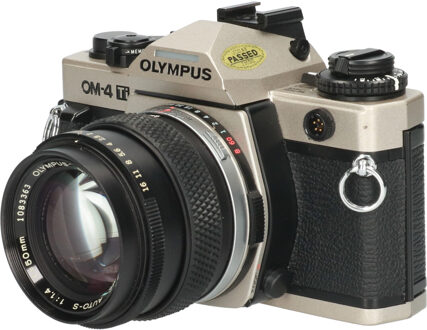
Olympus Tweedehands Olympus OM-4 Ti met Zuiko MC AUTO-S 50mm F/1.4 CM5251
Olympus Tweedehands Olympus OM-4 Ti met Zuiko MC AUTO-S 50mm F/1.4 CM5251
1-5 dagen
Gratis verzending
Niet op voorraad
- Thuiswinkel Waarborg
400,00


Gevonden bij 1 winkel vanaf
€ 400,-
(minder betalen?)
The OM-4 is the top-of-the-line body with shutter speeds up to 1/2000, released in 1983. The body is built on an all-new aluminum casting, with a new type of viewfinder including dioptric correction. With this camera Olympus introduced a new, versatile light-metering system. Besides the normal center-weighted metering the camera is equipped with a "Multi Spot" metering system that allows storage of up to eight measurements on a 2% central spot before making an exposure. The camera's computer electronics calculate the mean of the memorized light values to determine the optimal shutter speed. If desired, the calculated value can be retained for several exposures by using a "Memo" switch. There are also two "Hi Light" and "Shadow" buttons that are used only with spot metering. The "Hi Light" button applies an exposure correction of +2 EV, and is used when taking a spot reading on a light-tone subject for a high-key picture. The "Shadow" button applies the opposite correction of -21/3 EV to a spot reading on a dark-tone subject, to obtain a low-key picture. In addition, there is an ordinary exposure correction knob, under the rewind knob, that will work for both average and spot measures. The LCD display, visible at the bottom of the viewfinder, shows the shutter speed and the average or spot measures. It also reminds the user when any of the features described above are activated ("Spot", "Memo", "Hi Light", "Shadow" and/or exposure correction). An additional green light indicates that a dedicated flash is attached and ready for use.
The OM-4 was released at about the same time as the Nikon FA which introduced matrix metering. The two systems were innovative, but quite different: the OM-4 provides spot measurements and does the necessary computations, but it lets the photographer determine how he wants the picture to be exposed, while the FA compares the light pattern of the picture with a databank of commonly-occurring photographic situations, allowing the photographer to work faster and even palliating his knowledge deficiencies and actually beginning to think for him. (Nikon's approach was the one that would prevail among future 35mm and digital SLRs.) Among the few cameras to have a multi-spot metering system after the OM-4 were the Hasselblad 205 FCC and the Rollei 6008, some of the most expensive medium format cameras.